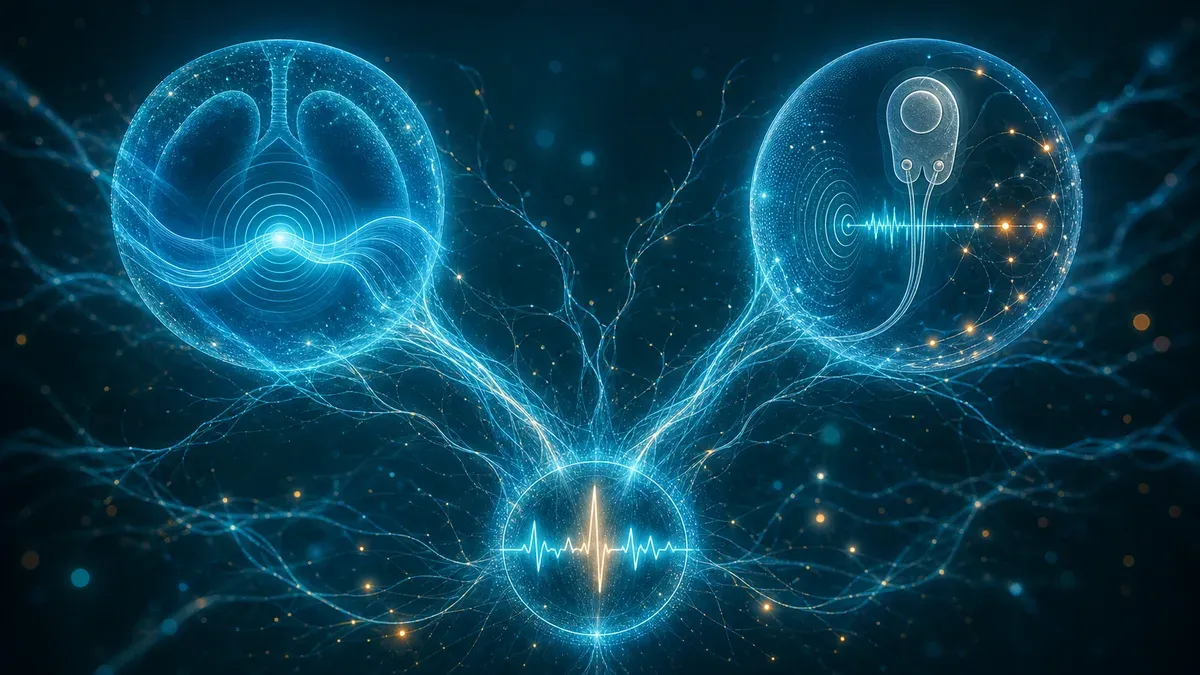
Your vagus nerve acts as your heart's natural brake pedal. It adjusts your heart rate and blood pressure through special nerve pathways. The right vagus nerve controls your heart's pacemaker (the SA node). The left side manages electrical signals between chambers. This creates a fast response system that keeps your heart balanced1.
How Does the Vagus Nerve Actually Touch Your Heart?
Think of your vagus nerve as having tiny sensors on your heart and blood vessels. These special nerve endings watch your body all the time. They check:
- Heart chamber pressure
- How strongly your heart beats
- Blood pressure changes in real time
These sensors send info back to your brainstem's control center (the medulla). It's like having a security system that never sleeps.
When your blood pressure spikes during stress, these sensors detect the change in seconds. They send signals to slow your heart rate and ease the pressure. This is why taking a deep breath after a scare feels so good. You're giving your vagus nerve the green light to hit the brakes.
Why Does Your Right Vagus Nerve Control Heart Rate Differently Than Your Left?
Your vagus nerve splits into right and left branches. Each has different jobs:
Right vagus nerve: Connects to your sinoatrial (SA) node -- your heart's natural pacemaker. When this nerve fires, it slows your heart rate. Think of it as the main speed control.
Left vagus nerve: Focuses on the atrioventricular (AV) node. This controls how electrical signals move between your heart's upper and lower chambers. It affects the rhythm and timing of your heartbeat.
This division means your nervous system can control both the speed AND the timing of your heart. It's like having separate controls for the gas pedal and transmission in a car.
Recent research suggests stimulating the neck portion may affect blood pressure2. The targeted approach works because different sections of the nerve control different parts of your heart.
What Happens During the Baroreflex Response?
Your vagus nerve serves as the main highway for one of your body's most important reflexes: the baroreflex. This system keeps your blood pressure steady without you thinking about it.
Here's how it works in real time:
- Detection: Pressure sensors in your arteries detect a blood pressure spike
- Signal: These sensors send a fast message through vagal fibers to your brainstem
- Response: Your brainstem tells your vagus nerve to slow your heart rate
- Result: Lower heart rate equals lower blood pressure -- usually within 2-3 heartbeats
This reflex happens thousands of times per day. Every time you stand up, sit down, get startled, or even take a deep breath, your baroreflex adjusts your heart through vagal pathways.
Research on breathing reflexes shows the vagus nerve can trigger heart rate changes when lung sensors detect certain signals3. The response time is very fast -- often under one second.
How Does This Connect to Your 'Rest and Digest' Mode?
Your vagus nerve is the main driver of your parasympathetic nervous system -- the "rest and digest" response. When this system turns on, several things happen to your heart:
- Heart rate slows down
- Blood pressure drops
- Blood flow shifts toward digestive organs
- Heart rate variability increases
This isn't just relaxation -- it's active recovery. Your vagus nerve doesn't just stop the stress response. It actively promotes healing and restoration.
The stronger your vagal tone, the better your heart adapts to daily stress. People with higher vagal activity show better heart rate variability. This links to heart resilience and overall health.
What Does Heart Rate Variability Tell You About Vagal Control?
Heart rate variability (HRV) measures the tiny changes in time between heartbeats. Healthy hearts don't beat like clocks. They adjust based on breathing, movement, and stress levels.
High HRV means strong vagal tone. Your vagus nerve is actively fine-tuning your heart rate moment by moment. Low HRV suggests your heart system is stuck in a rigid pattern. This often happens with long-term stress or reduced vagal function.
This variability isn't random. It reflects your vagus nerve's ability to:
- Respond quickly to changes around you
- Recover well from stress
- Keep your heart flexible
This measurement has become a key sign of nervous system health. It shows how well your vagus nerve talks to your heart.
Can You Influence This System?
Your vagus nerve controls heart function on its own. But certain practices may support healthy vagal tone:
- 4-7-8 breathing (inhale 4 seconds, hold 7, exhale 8): Directly stimulates vagal pathways through the diaphragm
- Cold exposure (30 seconds to 2 minutes of cold water on face or hands): Activates the dive reflex, which slows heart rate through vagal stimulation
- Meditation and mindfulness: May increase vagal tone over time
- Regular exercise: Supports overall nervous system balance
Some people explore vagus nerve stimulation techniques as part of their wellness routine. But responses vary a lot between people.
The key is consistency. Your vagus nerve responds to regular practice rather than occasional efforts. Think of it as training your heart's natural brake pedal to work better.